
Mew has always held a special place in Pokémon history as the mythical ancestor of all Pokémon. Over the years, it has inspired some of the most beautiful, iconic, and sought-after cards in the TCG.

Disclosure: We use referral links to our partner marketplaces, such as eBay and TCGplayer, for some of the collectibles featured on this page. If you make a purchase through one of these links, we may earn a small commission at no extra cost to you. It's a simple way to support our writers.
From timeless classics that spark nostalgia to stunning modern artworks that collectors chase, here is a balanced ranking of the best Mew cards ever released. We evaluated them based on historical significance, artwork quality, rarity, and overall collector demand.
20. Mew Prime (HS: Triumphant – 97/102)
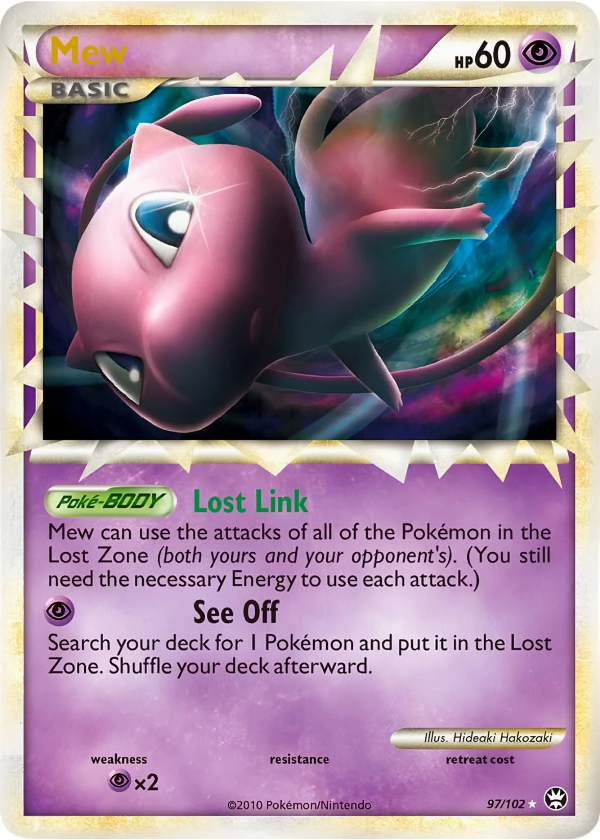

Released in 2010, Mew Prime is the standout card from the Triumphant expansion. “Prime” cards were the ultra-rares of the HeartGold & SoulSilver era, characterized by their unique, close-up “3D” portrait style and jagged, holographic borders.
Historically, this card was a competitive nightmare for opponents due to its “Lost Link” Poké-Body. It allowed Mew to use the attacks of any Pokémon in either player’s “Lost Zone” (a zone where cards are removed from play permanently). This created the infamous “Mew See-Off” strategy, where players would use Mew to send a heavy hitter to the Lost Zone and then immediately copy its attacks for a fraction of the energy cost.
19. Mew ex (EX Legend Maker – 88/92)
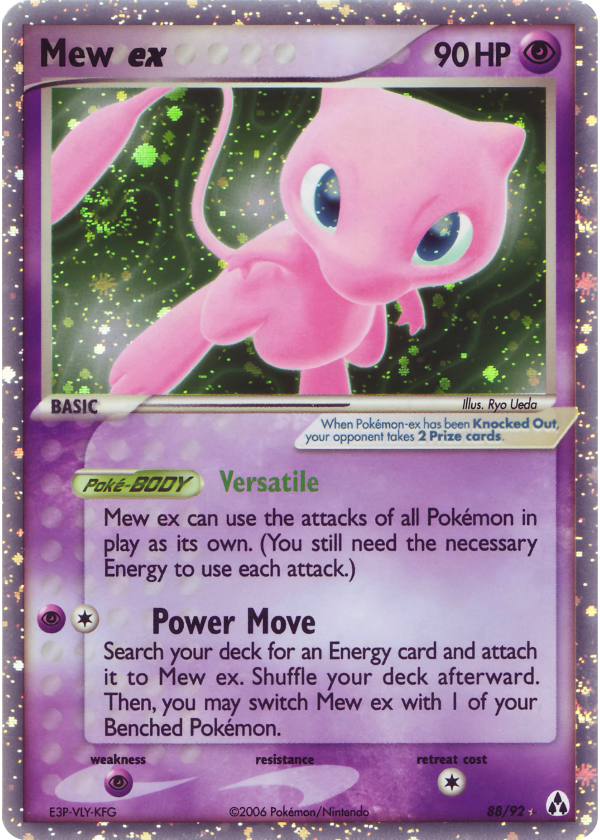
Released in 2006, this card is one of the most mechanically iconic versions of Mew in the game’s history. It is defined by its “Versatile” Poké-Body, which allows Mew ex to use the attacks of any Pokémon in play (yours or your opponent’s), provided you have the necessary energy.
Its historical significance is tied to its status as a “toolbox” king. In the mid-2000s competitive scene, this card was a staple because it could adapt to any matchup on the fly. It was so influential that it was even featured in the winning 2006 World Championship deck (“Suns & Moons”).
18. Mew VMAX Alternate Art (Fusion Strike – 269/264)
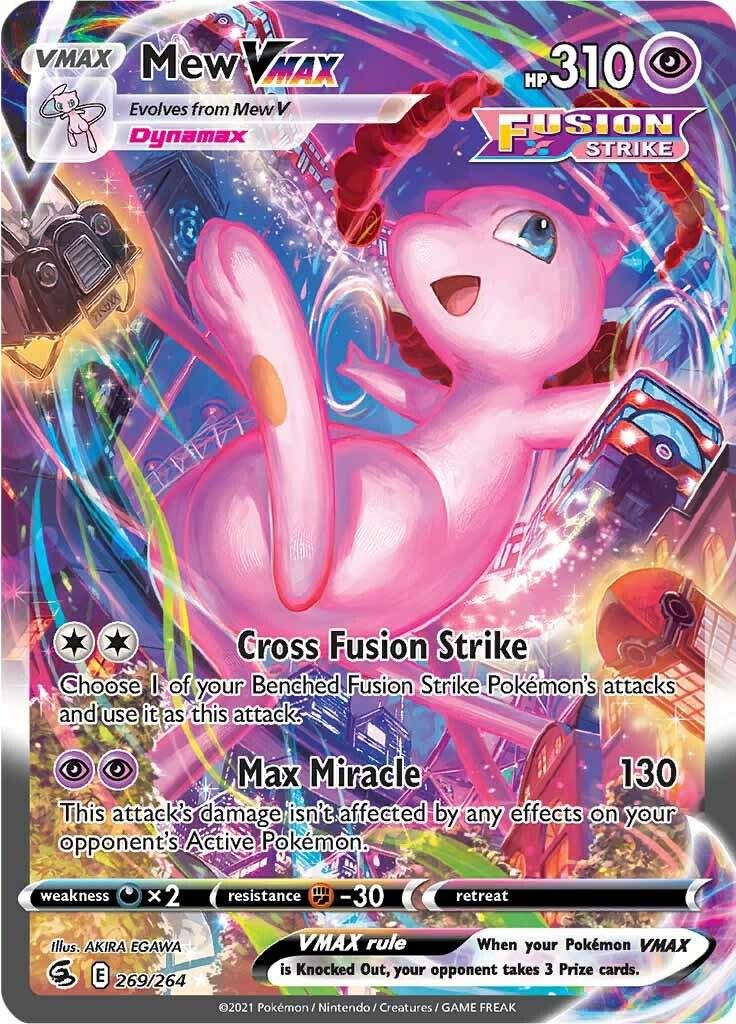
This Secret Rare Alternate Art is one of the top chase cards from Fusion Strike (2021). It features iconic artwork by Akira Egawa of a giant Mew lifting a bus and taxi over a miniature cityscape, earning it the fan nickname “Pink City Mew.”
The card was a competitive powerhouse. Its Cross Fusion Strike attack lets it copy any attack from a Benched Fusion Strike Pokémon. This helped make the Mew VMAX deck one of the most dominant archetypes in the Sword & Shield era, especially when paired with Genesect V.
Due to the large set size and low pull rates, it remains a highly sought-after “holy grail” for collectors, prized for both its playful large-scale art and strong gameplay impact.
17. Mew V Alternate Art (Fusion Strike – 251/264)
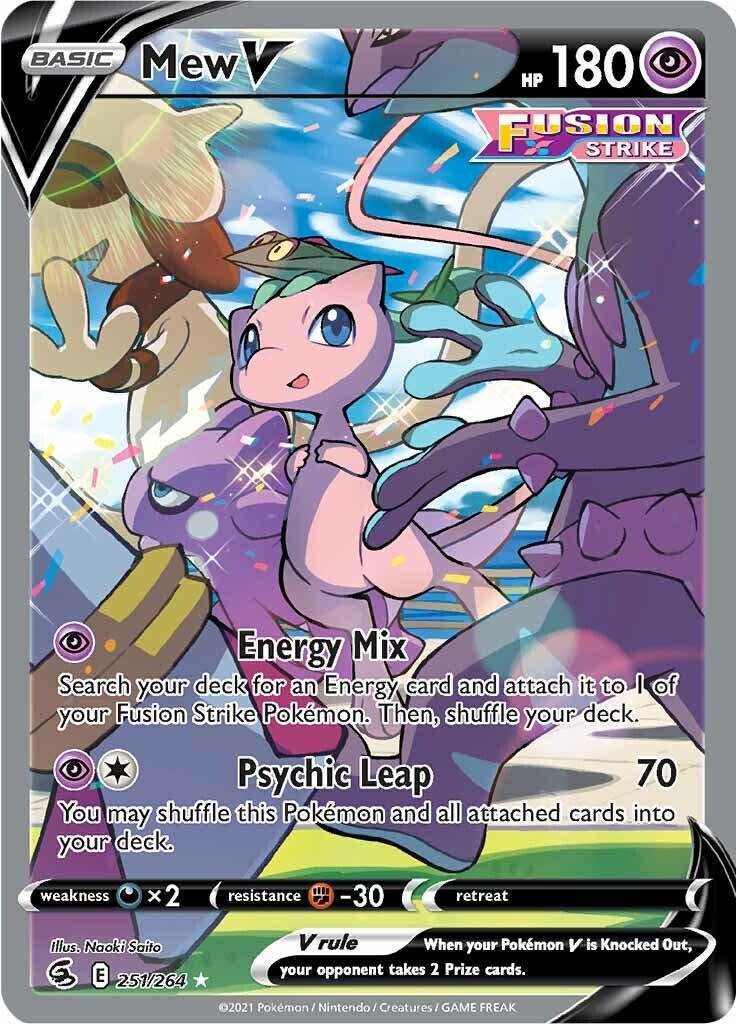
This Alternate Full Art card is one of the most popular pulls from the Fusion Strike expansion, released on November 12, 2021. The set was large and notoriously difficult to pull chase cards from, and this alt art quickly became a fan favorite thanks to the whimsical illustration by Naoki Saito. It shows Mew playfully floating alongside Smeargle, Toxtricity (Low Key Form), Dreepy, Toxel, and Hoopa Unbound.
Its appeal is mainly visual. It is widely regarded as one of the most crowded and lively Alternate Art cards of the Sword & Shield era. Mechanically, the regular Mew V (113/264) served as an important supporting piece in the dominant Mew VMAX / Genesect V deck. Its Energy Mix attack (one Psychic Energy) lets the player search the deck for any Energy card and attach it to one of their Fusion Strike Pokémon. This provided excellent first-turn energy acceleration to set up heavy hitters.
The Mew VMAX was the primary attacker in the archetype, while this Mew V acted as a key setup piece. In the years following its release, the card (and the Fusion Strike Mew deck) is remembered as part of one of the most powerful and influential archetypes of the Sword & Shield era.
16. Mew ex (EX Holon Phantoms – 100/110)
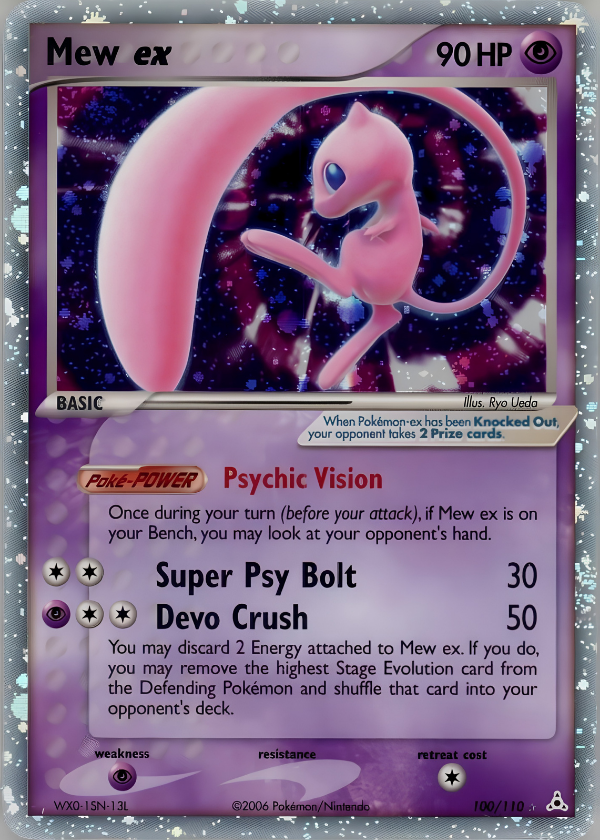
This card is a standout from the mid-2000s “ex” era, prized for its ethereal and hauntingly beautiful artwork by Ryo Ueda. Unlike most Mew cards that lean into a playful or cute aesthetic, this version depicts Mew in a misty, atmospheric environment that highlights its elusive and mythical nature.
Its historical significance is rooted in the “Holon” era, a fan-favorite period known for its experimental mechanics and lore. This Mew ex was highly competitive due to its “Psychic Shift” Poké-Power and its versatile “Devastating Beam” and “Replacing” attacks. For collectors, it is a difficult card to find in high grades because the high-gloss, silver-bordered “ex” cards from this period are notorious for “silvering”, a type of edge wear where the foil becomes visible along the sides. It remains a cornerstone of the EX Series and a must-have for any completionist.
15. Shining Mew (Shining Legends – 40/73)
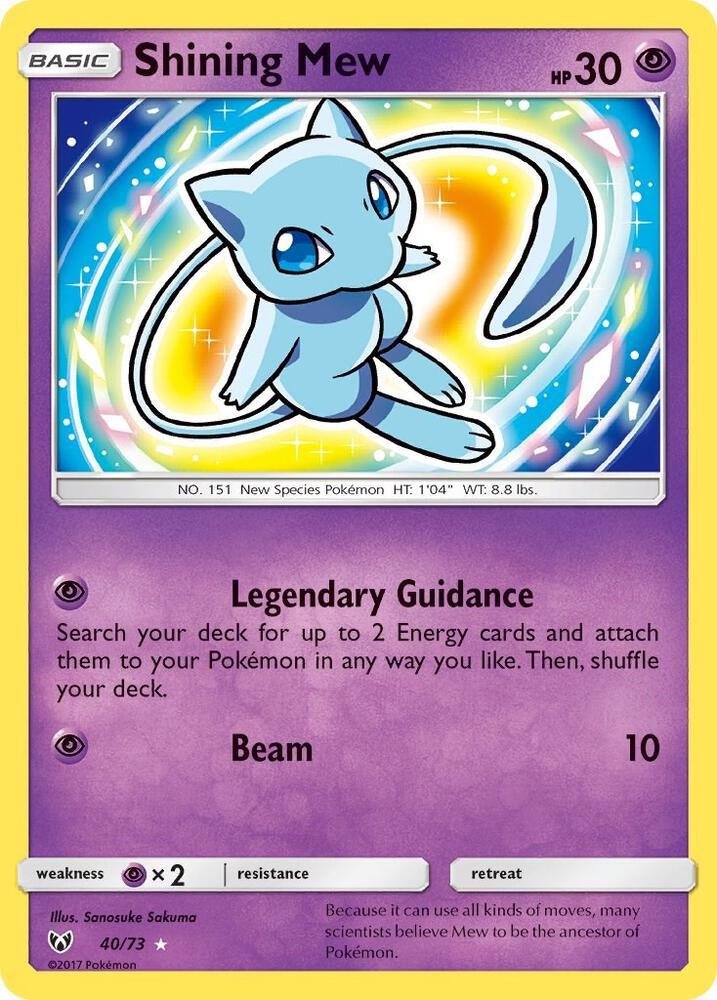
Released in 2017 as part of the special Shining Legends expansion, this card marked the triumphant return of the “Shining” mechanic after a 15-year hiatus. Just like its predecessors from the Neo era, this card features a unique textured foil on the Pokémon itself, making the “Shiny” blue Mew feel physically distinct from the rest of the artwork.
Its historical importance lies in being the most iconic pull of the Sun & Moon era’s tribute to legendary Pokémon. Because Shining Legends was a special “holiday” set, booster packs could not be bought individually and were only found inside Elite Trainer Boxes and special collection sets. This restricted supply, combined with the card’s gorgeous “Legendary Guidance” artwork, has made it a modern classic. It serves as a perfect bridge between the vintage “Shining” cards of the early 2000s and the high-detail “Illustration Rares” we see in the hobby today.
14. Mew EX (XY Black Star Promos – XY126)
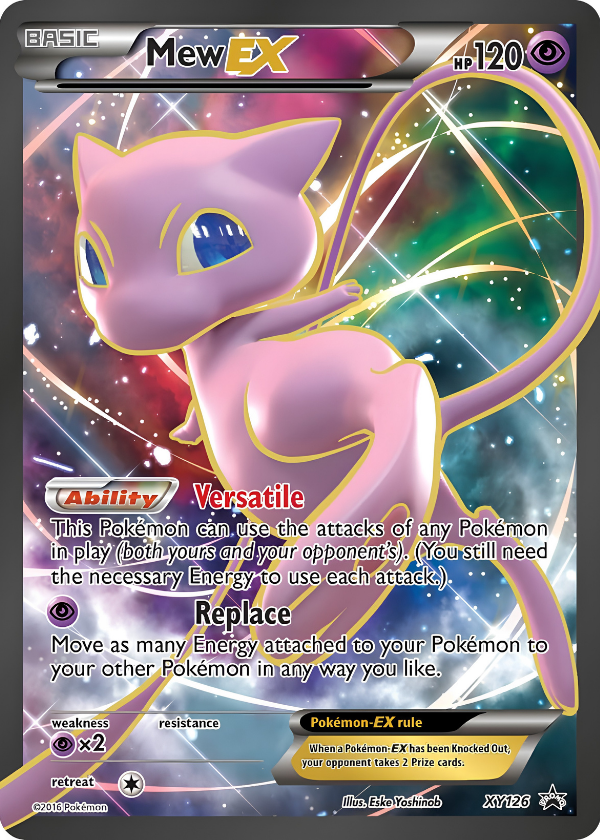
This Full Art promo was released in 2016 as part of the Mew and Mewtwo Super Premium Collection. It is not from a product called the Mewtwo-EX Legendary Collection. The card came in a high-end box set that included both the Mew-EX (XY126) and Mewtwo-EX (XY125) Full Art promos, along with Generations booster packs and other collector items.
Its main appeal is the Versatile Ability, which reads: “This Pokemon can use the attacks of any Pokemon in play (both yours and your opponent’s). You still need the necessary Energy to use each attack.” This made it a flexible, situational tech card in competitive play during the XY era. It often acted as a low-HP (120) glass cannon with high utility, capable of copying powerful attacks on the spot.
The card was widely available through the Super Premium Collection at the time of release and remains a popular Full Art Black Star promo among XY-era collectors for its striking artwork and unique gameplay role.
13. Mew ex (Scarlet & Violet Black Star Promos – 053)
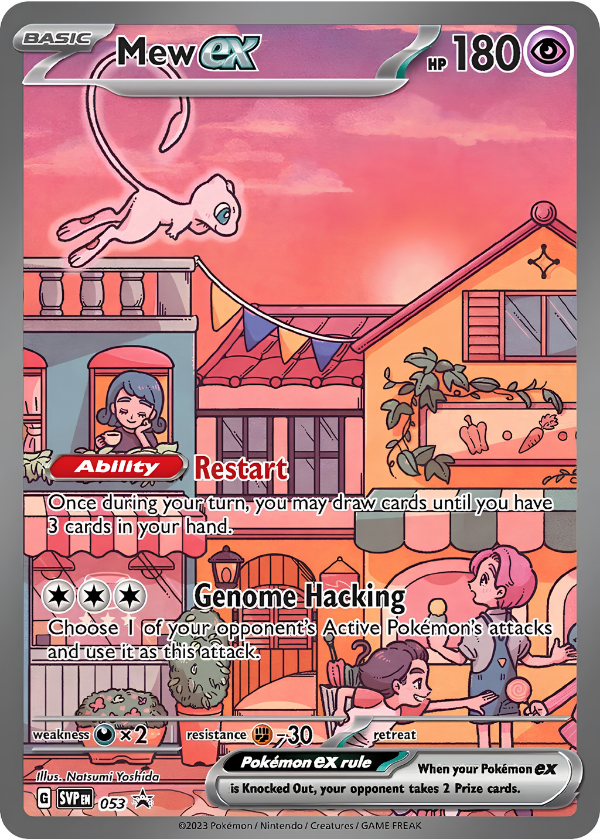
This card served as the face of the massive Pokémon 151 special collection in 2023. While the Japanese version was a standard pull in booster packs, the English version was released exclusively as a guaranteed promo within the “Ultra-Premium Collection” (UPC). It features a “Metal” variant in some boxes, but the standard etched Full Art version remains a favorite for its vibrant, gold-hued background.
Its historical significance is tied to the revival of the “ex” mechanic for the Scarlet & Violet era. With its “Restart” Ability, allowing you to draw cards until you have three in hand, it became an immediate staple for players looking for a consistent draw engine. For collectors, it represents the nostalgic peak of the 151 set, which brought millions of fans back to the hobby by celebrating the original Kanto Pokédex with modern, high-definition printing techniques.
12. Mewtwo & Mew-GX (Sun & Moon Promo – SM191)
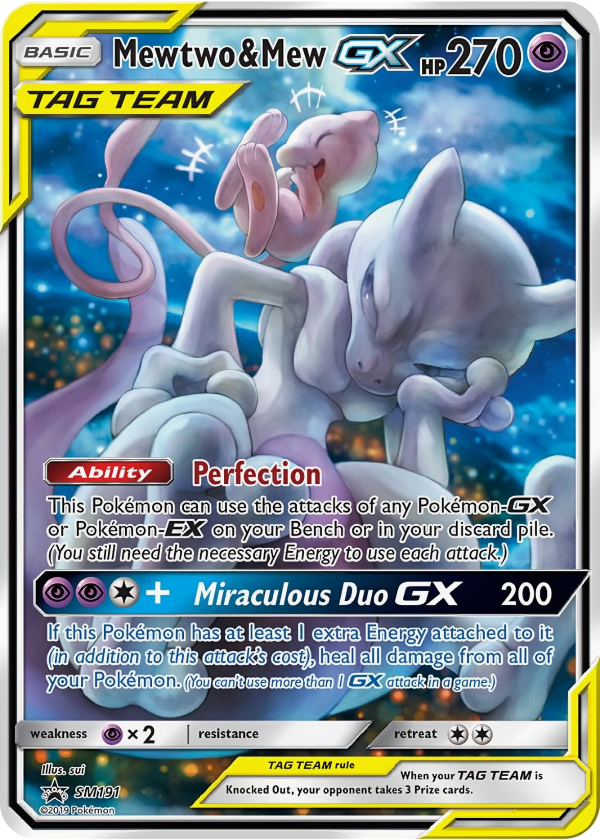
This card is the definitive “Tag Team” representative for Mew, featuring a high-energy collaboration with its clone, Mewtwo. Released in 2019 as part of the “Mewtwo & Mew-GX Power Connection Tin,” it quickly transitioned from a simple store promo to a competitive powerhouse and a high-value collector’s item.
Its historical impact is defined by its “Perfection” Ability. This allowed the card to use the attacks of any Pokémon-GX or Pokémon-EX on your Bench or in your discard pile, effectively making it a versatile “toolbox” that could adapt to any situation in the game. In the modern 2026 market, it is remembered as one of the most successful promo cards ever printed, balancing iconic character appeal with a gameplay mechanic that dominated the meta for years.
11. Mew ex “Bubble Mew” (Paldean Fates – 232/091)
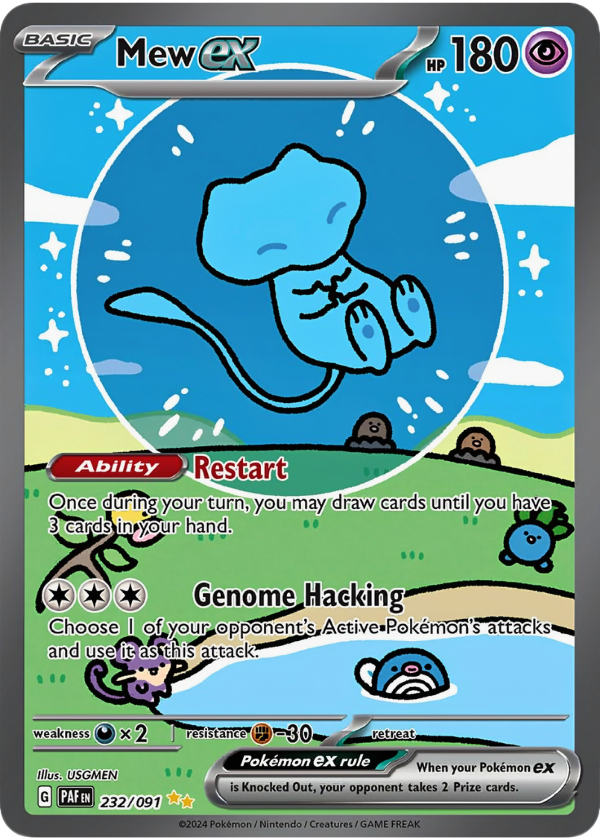
While most Mew “grails” are from the early 2000s, “Bubble Mew” is the modern exception. Released in the 2024 special set Paldean Fates, this Special Illustration Rare (SIR) became an overnight sensation. The nickname comes from the whimsical artwork by the artist USGMEN, which depicts a Shiny (blue) Mew floating peacefully inside a bubble above a colorful, stylized landscape.
Its significance lies in its departure from traditional high-intensity “Ultra Rare” art. The community fell in love with its simple, almost “lo-fi” aesthetic, which perfectly captures Mew’s playful and curious nature. Despite being a modern card, its price has skyrocketed in 2026, with collectors viewing it as the “Moonbreon” (the famous Evolving Skies Umbreon) of the Scarlet & Violet era. It is currently the most expensive and sought-after card in the Paldean Fates set, proving that modern art style can rival vintage rarity.
10. Mew (Pokémon Art Academy Promo – Winner: Phanpy)
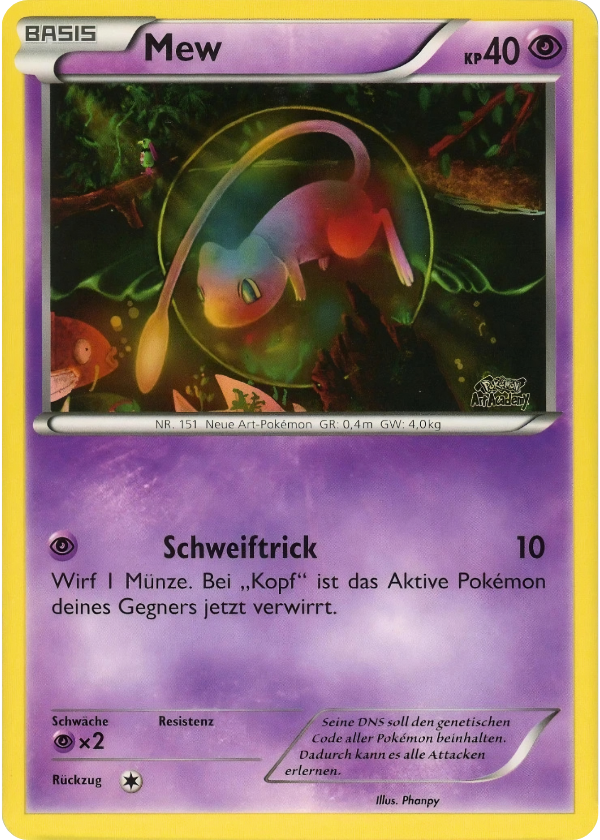
This card is a legendary “white whale” in the Pokémon world. Created for the 2015 Pokémon Art Academy competition on the Nintendo 3DS, this specific illustration by the German artist Phanpy was chosen as a winner in the “Your Favorite Pokémon” category.
Its historical significance comes from its extreme rarity. Unlike standard promos, only 100 copies were ever printed, and they were all delivered directly to the artist. Because these cards were never sold in stores or awarded at public events, they almost never enter the market. This Mew is considered a “Trophy Card” of the highest order, representing a rare moment where fan art was officially canonized by the Pokémon Company into a physical, high-value collectible.
9. Ancient Mew (2000 Movie Promo)
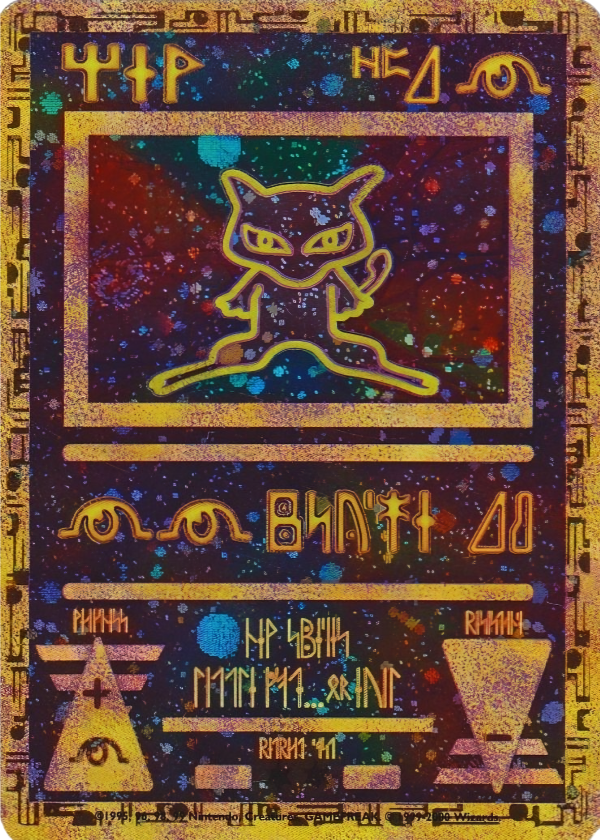
This is arguably the most famous Pokémon card ever printed. Distributed to moviegoers during the first week of Pokémon: The Power of One in 2000, it was an instant cultural phenomenon. Unlike any other card in the TCG, its text is written entirely in medieval Runic script, and it features a unique, shimmering “holofoil” pattern that covers both the front and the back.
In the lore, this card was a key plot device used by the antagonist, Lawrence III, to launch his quest to capture the legendary birds. Because millions of copies were printed, it is not particularly rare in terms of raw numbers, but finding a copy in “Gem Mint” condition is surprisingly difficult due to how easily the glossy surface scratches. It remains the ultimate nostalgia piece, representing the peak of the global Pokémon craze at the turn of the millennium.
8. Mew Black Star Promo (Wizards of the Coast – 9)
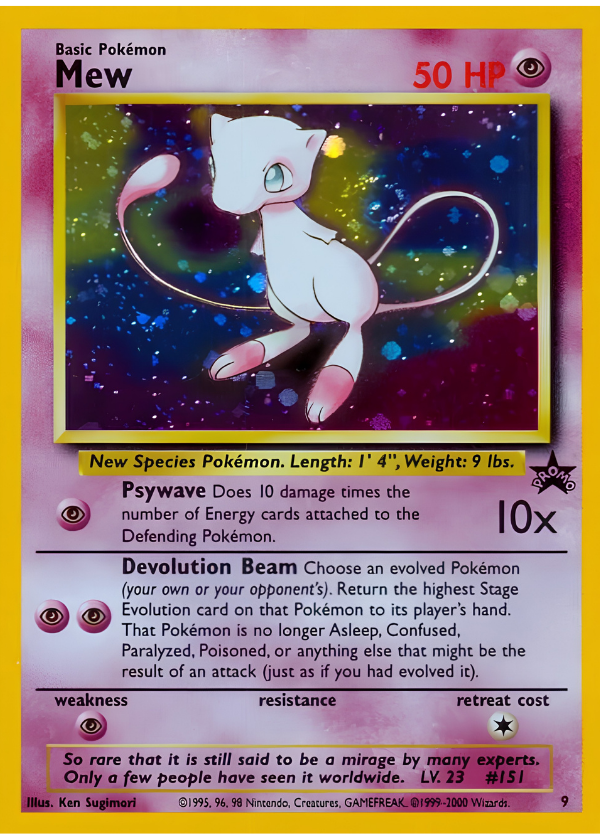
Distributed at official Pokémon League events starting in April 2000, this holographic Mew promo became one of the most important early cards for Western fans. Because Mew was nearly impossible to obtain in Pokémon Red and Blue without glitches or special events, this promo served as the very first physical proof for many children that the mythical 151st Pokémon actually existed.
Its historical significance is rooted in its status as the definitive “Movie 1” era artifact. During the height of the “Pokémania” craze, this card was a trophy for participating in local tournaments and mall events, transitioning Mew from an urban legend into a tangible part of the TCG. For a generation of players, owning this card was the ultimate badge of honor that completed their collection of the original 151.
7. Mew (Crown Zenith: Galarian Gallery – GG10/GG70)
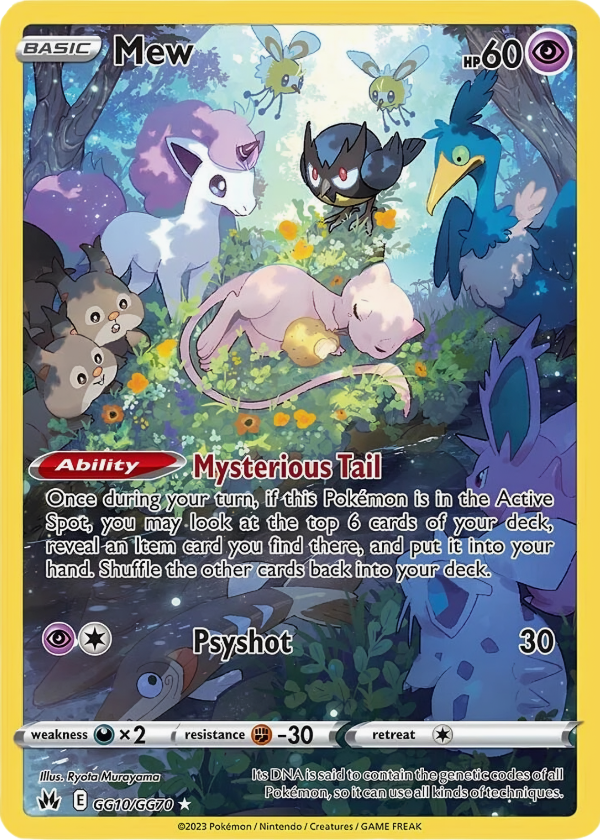
This card was a standout feature of the Galarian Gallery, a special 70-card subset within Crown Zenith that served as the grand finale for the entire Sword & Shield era. Released in early 2023, the set was designed as a “love letter” to collectors, featuring higher pull rates and experimental art styles that moved away from traditional TCG layouts.
Its significance lies in its accessibility and universal acclaim. While many high-end Mew cards are locked behind massive price tags or tournament wins, this version provided a masterclass in “Illustration Rare” design that was obtainable for the average fan. It is widely credited with helping define the modern era of the hobby, where the artistic narrative and “vibe” of a card are just as important to its value as its competitive power.
6. _____’s Mew (PLAY Promo – 013)
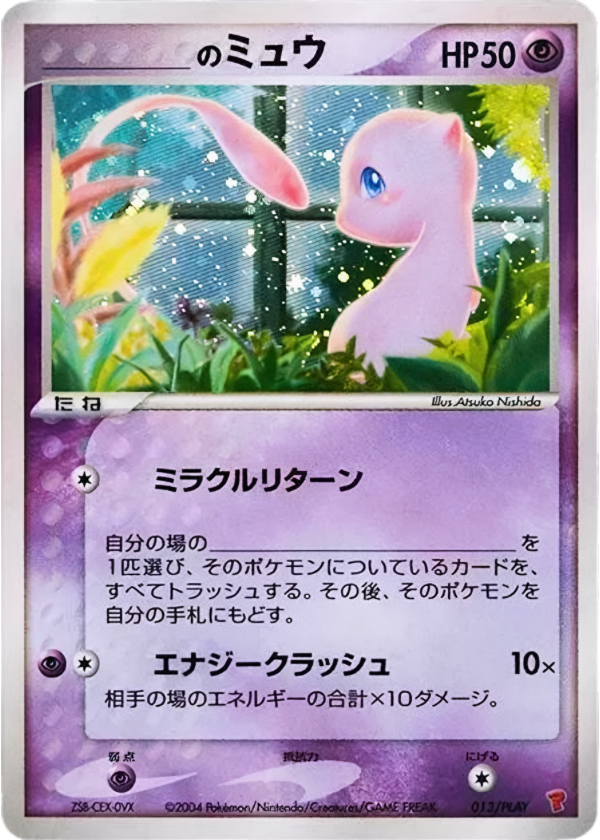
This card was a high-tier reward for members of the Japanese “Pokémon Players Club” during its 2004 and 2005 seasons. Unlike cards found in packs, it could only be obtained by accumulating EXP points through official organized play, requiring 15,000 EXP during the first two seasons and later reduced to 7,000 EXP in the third and fourth seasons, demanding a massive commitment to attending local events and tournaments.
The “blank line” in the name is a direct callback to the classic “Owner’s Pokémon” from the Gym Heroes era, allowing the player to figuratively “sign” the card as its trainer. It is highly regarded by collectors for its unique interactive name and the extreme dedication required to earn an original copy during the early years of Japan’s professional play circuit.
5. Mew [Gold Star] Delta Species (EX Dragon Frontiers – 101/101)
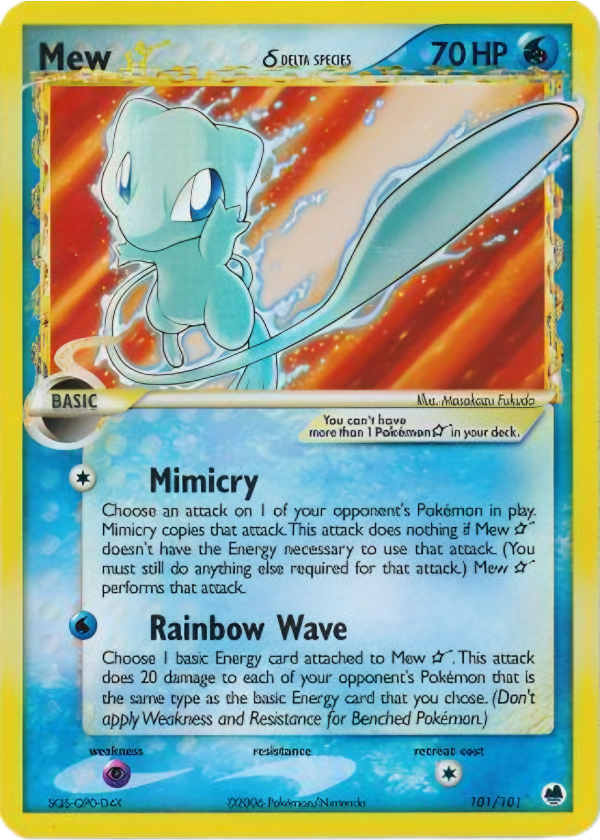
This card is the undisputed holy grail of the mid-2000s EX era. Gold Star cards were notoriously difficult to pull, appearing on average in just 1 out of every 72 packs.
Its massive historical significance lies in combining the “Delta Species” lore (which canonically mutated this classic Psychic-type into a Water-type) with the Gold Star mechanic that showcased its ultra-rare blue shiny form. It remains one of the most coveted and high-value chase cards in the entire hobby.
4. Mew (Expedition – 19/165)
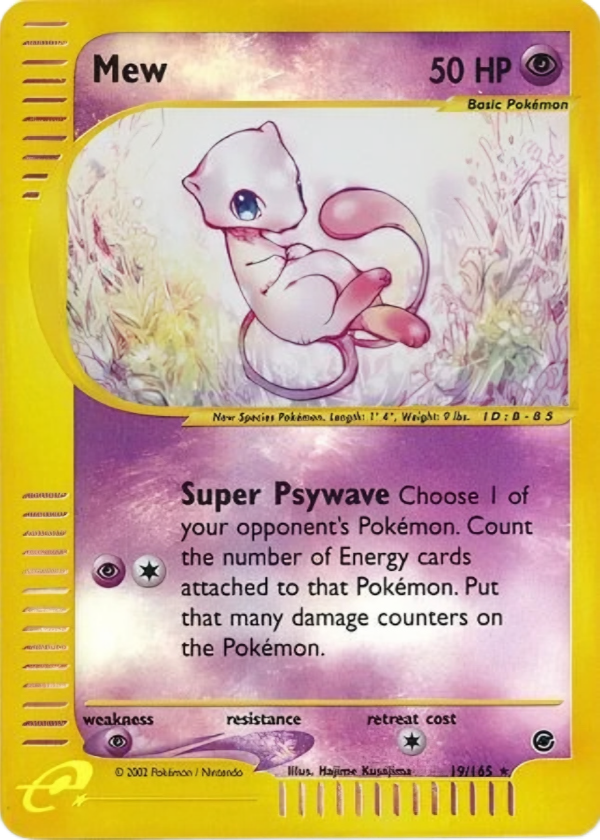
This card is a standout relic from the “e-Card” era of 2002, the final chapter of the Wizards of the Coast (WOTC) partnership. Its most striking feature is the thick, barcode-laden border on the left side, designed to be scanned by the Nintendo e-Reader peripheral for the Game Boy Advance to unlock hidden data, mini-games, or unique sound effects.
Historically, this Mew is highly prized for the dreamlike artwork by Hajime Kusajima, which is considered one of the most aesthetically pleasing depictions of the Pokémon in the early TCG. Because Expedition had a lower print run than earlier sets like Base or Jungle, and since the “e-Series” cards are notorious for being easily damaged, finding a holographic copy in high grade is a significant challenge for collectors. It represents the brief, experimental moment when Pokémon tried to bridge the gap between physical cards and digital gameplay.
3. Mew ex (Chinese Promo – 003/SV-P)
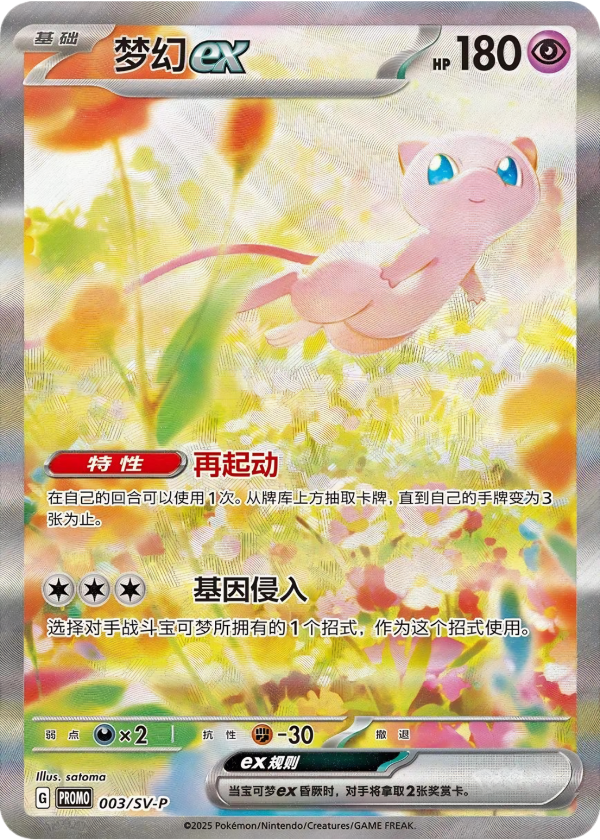
This exclusive Chinese promo is one of the ultimate holy grails of modern Pokémon card collecting. Released exclusively in Mainland China to celebrate the launch of the Scarlet & Violet: 151 set, it had an incredibly restricted distribution. Exactly 1,510 copies were produced, a clever reference to Mew’s Pokédex number, 151.
To even stand a chance at owning one, fans had to complete a quest participating in official tournament venues across China just to qualify for a monthly lottery draw. Because of this extreme barrier to entry and minuscule print run, this card is a legendary white whale that commands thousands of dollars on the secondary market. It is easily one of the most significant and difficult-to-acquire international promos in the hobby’s history.
2. Mew (Southern Islands – 1/18)
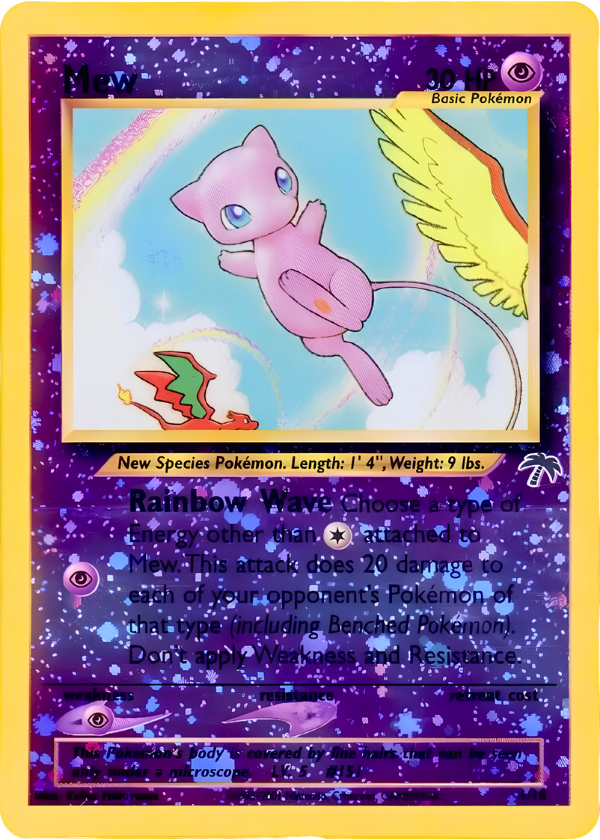
This card served as the face of the Southern Islands collection, an 18-card mini-set. The set was first released in Japan in 1999 as a tie-in with the second Pokémon movie (Pokémon: The Movie 2000). The English version followed on July 31, 2001. In Japan, it originally came in two decorated tropical-themed folders (Rainbow Island and Tropical Island), each containing nine cards. The English release compiled them into one cohesive set sold as a complete collection.
Its historical charm comes from the artwork by Keiko Fukuyama. The Mew card forms part of a larger panoramic scene that connects with the Pidgeot (2/18) and other cards in the set to create a continuous tropical island mural.
In the English release, the card features a distinctive holofoil pattern with a starry design across the entire card surface (not just the artwork area). This gives it a unique sparkling look that stands out among early Wizards of the Coast era cards. It remains a nostalgic favorite for collectors who remember the tropical-themed Pokémon products of the early 2000s.
1. Shining Mew (CoroCoro Comics Promo – No. 151)
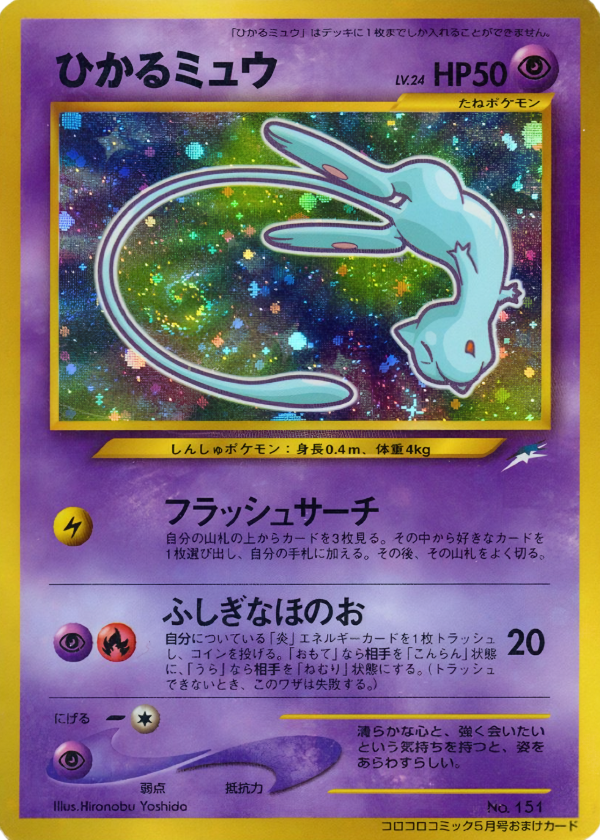
This legendary card was released in the May 2001 issue of Japan’s CoroCoro Comic magazine. It stands as one of the earliest Shining Pokémon cards, featuring a distinctive full-card holofoil with a shimmering “stardust” effect that sets it apart from later releases.
Because it was a magazine insert, the card was never released in English, making it a permanent exclusive to the Japanese hobby. It remains one of the most beloved promos in history due to its unique aesthetic, notably featuring a cool-toned, blue-hued Mew rather than its traditional pink, and as an early example of the concept later expanded in the Neo Destiny set. High-grade copies are particularly rare, as the magazine distribution method often led to edge wear and corner damage.

Disclosure: eBay links on this page use a referral system that helps support the content, at no extra cost to you.